
07720 425 897

Baby-led breastfeeding

5 Mar 2026 | breastfeeding

Your healthy, full term baby is born with the reflexes and instincts to breastfeed.  You do not need complicated instructions or technical videos, you and your baby can figure this out, especially if you snuggle uninterrupted skin to skin.  Your baby retains the skills to feed by instinct for many weeks, it is never too late to start.

First, get yourself comfortably reclined.  Lean back, relax, use cushions or pillows for support if you want to.  Think about what feels good for your body.  Reclining will keep your baby’s body naturally held against yours, so there will be no strain in your neck, shoulders or arms.

You might be more comfortable lying on your side in an adult bed.  This fully supported position is super relaxing for you and your baby and a very common way to sleep, so set it up safely according to the Safe Sleep Seven.
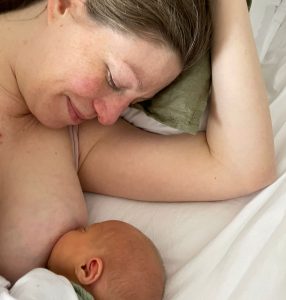
Look at where your breast naturally hangs in whichever position you have chosen.  You are not going to move your breast unless necessary to make it easier for both of you.

Cuddle your baby against you, with their front fully in contact with your body, where their mouth can easily reach the nipple. It is the position you would use to cuddle them for a contact nap or co-sleeping in bed, just putting their mouth where the nipple is! When your baby has their tummy in contact with you, their hands free and either side of the nipple, their hips, knees and feet against you, it allows them to relax and use their feeding instincts.  You might not see these instincts at all if they are cradled with their tummy up to the ceiling instead of against you, or if someone is wrestling their hands out of the way, or their body is not touching your very much.  Gravity should be doing the work, they are pressed naturally against you rather than falling off or down your body.

Work with your little one, watching their incredible natural instincts.  Your baby is looking for a darker area of skin, they see in black and white.  Nipples smell like milk and amniotic fluid, your baby orientates this way.  The texture of your nipple under their cheek makes them turn their head towards it.  Their kneading hands make the milk flow and the nipple stand up as far as it can.  You will see them bob onto your nipple with their mouth open and tongue down. They suck in the breast tissue and start to drink.  Just like all other mammals.  Just like nature intended.

Feel it.  Make minor adjustments if you need to. If they are snuffling, tuck their bottom in closer to yours or move them a fraction down towards their feet to tilt their nose up. If your breast tissue is tugging, move them towards the tug. They will be most comfortable with both cheeks and their chin touching the breast, you might provide support with your arm to stop them turning too far one way or the other.  It is a beautiful dance between you.

You will meet many people who still instruct mothers to grip the back of their baby’s neck, push their shoulders, squish the breast and guide the nipple into the baby’s mouth.  Some of these things are occasionally helpful for women depending on their unique anatomy.  Overall, however, the science has moved on. Our best evidence suggests that the more natural approach detailed above results in significantly less discomfort and nipple trauma, increased breastfeeding rates and duration. Why not give it a try and see how you and your baby can learn together, snuggle and bond, and enjoy relaxed and painless feeding?

Recent Posts

Is your baby tracking app actually helping?

When I sit down with a new mum to talk about feeding, she almost inevitably reaches for her phone. “Look, his feeds lasted an average of 29 minutes yesterday, four hours forty seven minutes in total, and here he was overtired in his wake window, and he didn’t get a...

Bottle refusal nightmares

I hear you. It’s getting desperate. You’ve been trying for months to get your baby to take a bottle. You’ve read every forum, your kitchen is bursting with bottles of all shapes sizes and flow rates. You’ve tried all the milks at different temperatures, calm,...

How to choose infant formula milk

In the UK a standard first formula labelled 1 of any brand will suit most babies.  Ready to feed formula is considered safest for your baby in the first two months. Many parents find anxiety levels rising when confronted with the huge choice of formula milks...

How to choose a bottle

Pick a bottle and teat flow rate suitable for the age of your baby.  You might need to experiment to find the optimal bottle for your little one.  Conical teats tend to be well tolerated by many babies. New parents often worry about what to buy for their baby, and...

Bottle feeding stress?

Bottle feeding isn’t the easy option! I have worked with thousands of bottle feeding parents. You are not alone with your worries. Here are the top ten things bottle feeding parents stress about. 1. Guilt Whether bottle feeding was a positive choice or forced upon...

Breastfeeding with nipple piercings or tattoos

Can I breastfeed with pierced nipples? Yes! Please remove your nipple jewellery before breastfeeding. Jewellery can easily get dislodged or damage your baby's mouth. Most people take it out for the whole time they are breastfeeding their baby, others do it feed by...

Bottle feeding your fussy four or five month old

Your little one was doing fine with the bottle.  You were feeling slightly smug about the great patterns you were getting into. Maybe they were even sleeping a good chunk of the night.  Then, from nowhere, they only want to take a few sucks on the bottle and refuse...

Why bottle feed?

As a lactation consultant, I am widely expected to promote breastfeeding, and of course I help families with this. Breastmilk is the optimal food for human babies and breastfeeding can be awesome. However, bottle feeding is a vital part of many families’ feeding...

Top ten reasons why your baby won’t take a bottle

About half of my work is with parents of babies who cannot bottle feed well or refuse a bottle entirely.  Frazzled parents are often at the end of their tether, their baby is unhappy and feed times become a nightmare.  Sometimes there is a clock ticking, such as a...

Shall I harvest colostrum before the birth?

Many midwives suggest that women hand express and collect their colostrum from about 37 weeks pregnant.  It is considered a useful and empowering skill to learn, and the extra colostrum would benefit an unwell baby. Colostrum harvesting could be particularly helpful...

Feeling like a breastfeeding failure?

Lots of new mums have cried on me this week.  And every week for the last eighteen years, to be honest. They say heartbreaking things like: “I cannot fully breastfeed my baby, I am letting him down”“I have failed at breastfeeding” “I feel terrible when I need to give...

Your top five bottle feeding questions answered

As I work with new parents on both breast and bottle feeding, I get asked a lot of questions about bottles. These are short answers.  If you have specific questions about bottle feeding your baby please reach out to me or your healthcare providers. 1. Will my baby get...

Low milk supply? Check these things.

Why is supply low?  This article starts with the most obvious reasons, and works through some more that you might not have heard of. For your breasts to make milk, they need to have functioning breast tissue with intact nerves and blood supply, and your body needs to...

Why write a book?

My new book Breast, Bottle or Both: How to Feed Your Baby Your Way is about to come out in paperback on Kindle, Apply and Google Play Books. With so much information available free online, why did I bother putting something in print? Parents are overwhelmed with...

LGBTQ+ baby feeding

All parents deserve informed, kind and unwavering support. In this article I share feeding questions and experiences of some of the families I have worked with, partly to open everyone's eyes to what might be possible. I know, I am a fifty plus white middle class...

How to avoid sore nipples

My job is to help mums and babies to feed comfortably and effectively. Lots of women complain about sore nipples and many think it is normal to have pain in the early days. But pain is a sign that something is wrong. Breastfeeding should be relaxed and enjoyable!  If...

Can I take breastmilk or formula through airport security?

Yes!  The only thing you cannot take in hand luggage is frozen breastmilk. Here are the Government guidelines for travelling from the UK. Baby food and baby milk When travelling with a baby you’re allowed to take enough baby food, baby milk and sterilised water for...

Why we need to talk about bottles

My new book Breast, Bottle or Both, comes out this week.  I am thrilled that new parents will have non-judgmental support and guidance in all aspects of feeding their baby.  I am also really nervous.  Why?  Because strangers online are likely to share their very...

Do I need to pump and dump?

We all want to keep our babies safe and protect them from harmful substances in our breastmilk.  So when is it necessary to express milk and throw it away? Right up front, I really don't like the phrase "pump and dump."  Expressing milk is an act of love from a mother...

How can I breastfeed and return to work?

It is often possible to continue breastfeeding your baby after a return to work away from home. If you are employed, talk to your employer about breastfeeding before returning to work.  Your next steps depend on the age of your baby and your breastfeeding goals. Here...