
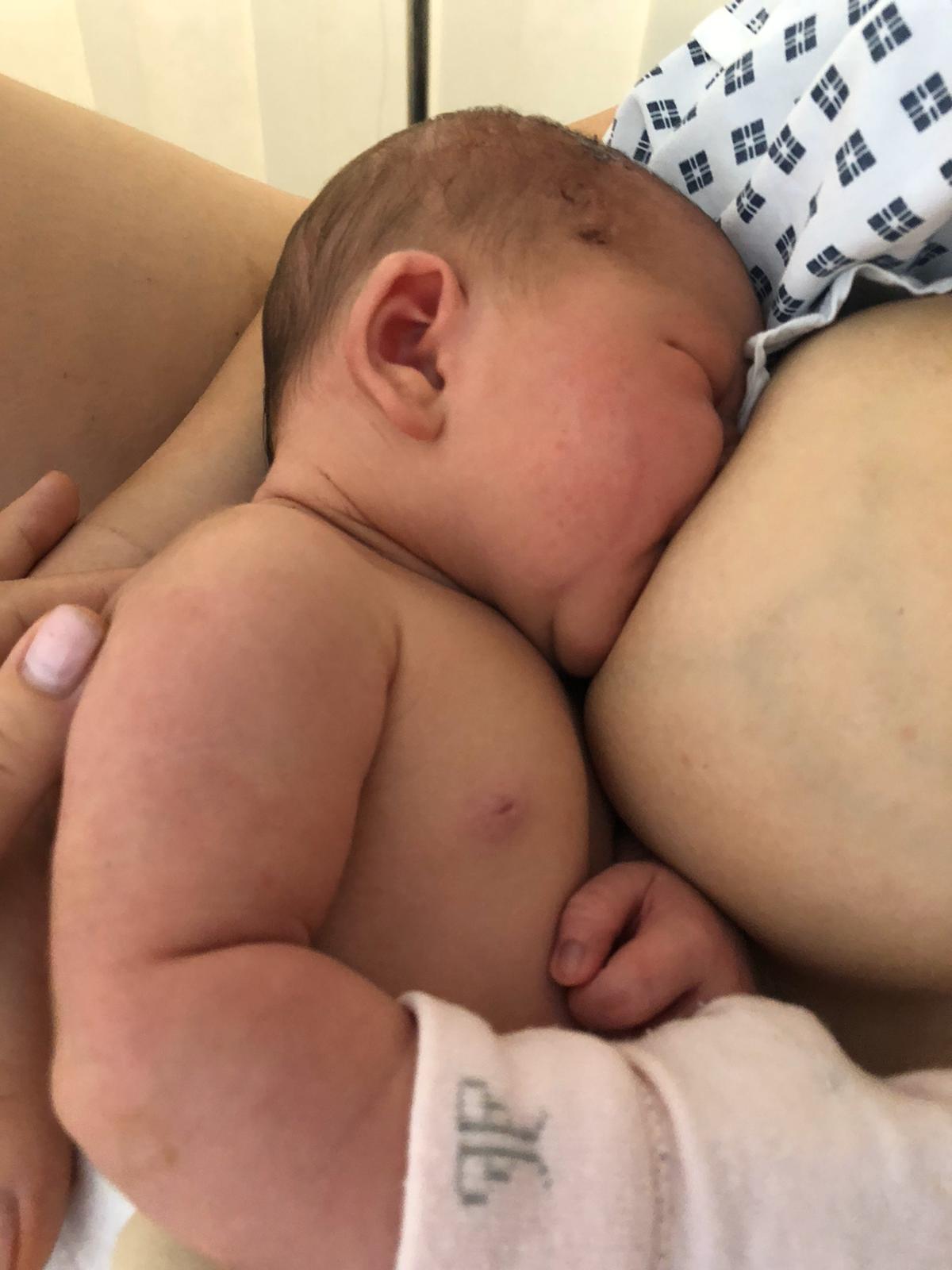
“My sister told me that breastfeeding was hideous for a fortnight”
“I read that a correct latch should be painless”
“Everyone says that breastfeeding hurts for the first few weeks and then your nipples settle down”
“The midwife explained that sore nipples are normal because they have never had this much attention before!”
It seems that there is conflicting information on pretty much everything to do with parenthood! Who is right? Should breastfeeding hurt? And if it does, what can you do about it?
Should breastfeeding hurt?
I suppose, in short, not really! Pain is generally a sign in the body that something is wrong and a prompt to do something about it. I am not denying that many women get sore nipples. However, experience tells me that in most cases we can work together to reduce the pain or make it go away entirely.
So why do many women find breastfeeding painful?
There are several factors at play here. It is true that most of us are not used to having someone suck on our nipples for up to 12 hours a day, and some sensitivity might be expected. It is also true that while sucking is an instinct for most babies, it can take baby and mum some time to work out how to get the best fit together.
In my experience, nine times out of ten, a woman gets sore nipples from less than perfect positioning and attachment. Often the baby is tugging the nipple away from where it naturally hangs, or baby is not deeply attached so they squash the nipple against the roof of their mouth. Either way, the nipple tends to come out of baby’s mouth looking pinched and can even get cracked and bloody. Not surprisingly, a mother can start to dread the next feed. Sometimes this kind of squishing results in vasospasm, which causes the nipple to go white during and after feeds and gives shooting pains in the breasts even between feeds. Mothers are often misdiagnosed with nipple thrush, when actually incorrect attachment is the issue.
The good news is that a lactation consultant can often really help to see what is going on and stop the pain. I have worked with so many women who delightedly exclaim “oh wow, it isn’t hurting, this is so lovely” when we find a position that works for them, even when they had been about to give up breastfeeding five minutes beforehand. Here is more information on achieving a good latch
Most GPs, midwives and health visitors are not extensively trained in breastfeeding. Having a quick glance at you and saying “it looks alright to me” is not the same as a proper assessment of a breastfeed. If you are in discomfort, please seek out some trained support.
On occasions, it isn’t a position and attachment issue. There are wide variations in babies’ mouths and tongue function that can impact on feeding. If you are unsure, please get referred for specialist assessment.
It is estimated that anything up to 10% of babies are born with a tongue-tie when the piece of skin (frenulum) from the base of their tongue to the floor of their mouth may restrict the movement of their tongue. These babies may have trouble staying on the breast, and often have “crunchy” shallow sucks that hurt the nipple. While working on positions and attachment can often help, in severe cases it is unlikely to resolve the pain entirely. If you think that tongue-tie might be your issue, please ask your midwife or GP for a referral to a specialist who can fully assess the tongue function and if necessary perform a simple surgical procedure to release the frenulum.
Some temporary issues also come into play, such as birth injuries and medications. Babies that have spent hours being impacted by labour contractions, especially if they were not in a great position, might well have a sore neck! Forceps and ventouse births can result in visible bruises, and undoubtedly a bit of reluctance to open their mouths wide and jump onto the breast. Little ones may be impacted by the drugs that were necessary for mum during labour or after delivery. Many of these issues resolve by themselves in time. Some mothers find that an osteopath trained in paediatric care can help their little one.
I have seen a couple of cases where a tiny baby simply could not fit their mother’s larger than average nipple into their mouth. There is nothing to do here except regularly express the breastmilk until the baby grows.
Some women suffer from pre-existing breast conditions that can make feeding sore. If you are in any doubt, please see your GP. I have seen tens of women with Raynaud’s Phenomenon who find breastfeeding very painful. If you know or suspect that you have Raynauds (a circulation condition where the extremities especially fingers go white in the cold), you might find that keeping the breasts as warm as possible may help. There are medications available in extreme cases, it would be worth discussing these with your GP.
There are certain nipple shapes and structures that, while normal, can make it more challenging to breastfeed pain free. Inverted nipples, that retract rather than protrude when baby sucks on them, can sometimes cause a mother some pain. I suggest getting help from a trained breastfeeding specialist to work on optimising latch on flat or inverted nipples. Some babies struggle to latch or begin sucking, and we have hints and tips on how to achieve a good latch. Many nipples look inverted but can be coaxed out, and that is a good sign that baby will be able to do the same. However, some are tethered inside and may hurt during breastfeeding no matter what we do.
Breast infections can cause a mother discomfort, and if you are at all worried about what is happening with your breasts or nipples please seek diagnosis from your medical professionals. Thrush of the nipples can result in itchy, scratchy, “broken glass” or “needle” type pain in the nipple and shooting pain in the breast tissue. However, thrush is often misdiagnosed when incorrect latch is actually causing the problem. It is very unlikely that breastfeeding pain that happens from birth is thrush. For much more information on diagnosing and treating nipple thrush, please see my article.
So, if my nipples hurt, I should get some support?
Yes! Absolutely. Please do not suffer unnecessarily. There is so much that trained breastfeeding consultants can do to help you reduce or take away the pain, or at least work with you to understand what is going on and signpost a way forward.
For more information
Good latch
Inverted nipples
https://breastfeeding.support/breastfeeding-inverted-nipples-flat-nipples/
Tongue tie
https://kellymom.com/health/baby-health/bfhelp-tonguetie/
Raynauds
https://breastfeedingnetwork.org.uk/wp-content/pdfs/Raynauds%20and%20bf.pdf
Thrush
Vasospasm