

Many of us will have seen our lingual frenulum, it is the membrane underneath the tongue that links the bottom of the tongue and the floor of the mouth. There are natural variations in the thickness and position of the frenulum, and in some people it is not visible at all.
When the membrane under the tongue is short or tight, it is called a tongue-tie, or ankyloglossia. Many parents, especially those experiencing ongoing breast and bottle feeding difficulties, worry that their baby’s tongue might be to blame. It can be a good idea to seek a specialist assessment from someone trained in breastfeeding and tongue-tie to be sure.
The NICE Guidelines in the UK suggest that many tongue-ties do not cause symptoms and do not require treatment, and that some resolve by themselves over time. However. some practitioners believe that if a baby with a tongue-tie is having trouble breastfeeding, they should have surgical division of the lingual frenulum as soon as possible.
The NICE Guidelines state “current evidence suggests that there are no major safety concerns about division of ankyloglossia (tongue-tie) and limited evidence suggests that this procedure can improve breastfeeding. The evidence is adequate to support the use of the procedure…”
How many babies are affected by tongue-tie?
The short answer is, we don’t know. Research suggests that anything from 3-10% of babies could be affected. A study of 400 babies in 2019 suggested 9% had tongue-tie.
What? Why don’t we know?
While babies are checked for tongue-tie as part of their newborn check, this is not a full or comprehensive assessment of tongue form and function. The process for assessing and grading tongue-ties is not yet universal, individual practitioners use different methods, so to be honest the research is a little flaky. It seems that some babies who appear visually to have a tongue-tie go on to feed perfectly well and never need follow up. Others will not breastfeed well and may be put straight onto a bottle. In either case, we do not always know the outcomes.
What would I look for?
Some tongue-ties are really easy to spot. Where the membrane is attached at, or close to the tongue tip, the tongue tip may look blunt, forked or have a heart shaped appearance. These are known as anterior tongue ties.

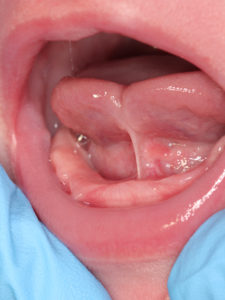
However, where the membrane is attached further back the tongue may look normal. These are sometimes called posterior tongue-ties. They can still make it hard for the baby to use their tongue properly and feed well.
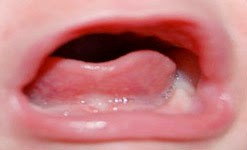
As we have seen, tongue-tied babies with feeding problems may benefit from treatment to release the restriction that the membrane is having on the tongue and enable them to feed effectively.
How do I know that a tongue-tie is causing problems?
It can be hard to know, as many issues cause breastfeeding problems.
If your baby has tongue-tie, you might have:
- Sore, damaged, bruised nipples
- Nipples which look misshapen or blanched after feeds
- The feeling that baby is crunching or biting your nipple during feeds
- Blocked milk ducts and/or mastitis without another obvious cause
- Low milk supply
- Exhaustion from frequent/constant feeding
- Distress from failing to establish breastfeeding
Your tongue-tied baby might experience:
- Restricted tongue movement
- Small gape resulting in biting/grinding behaviour
- Unsettled behaviour during feeds
- Difficulty staying attached to the breast or bottle
- Frequent or very long feeds
- Excessive early weight loss/ poor weight gain/faltering growth
- Clicking noises and/ or dribbling during feeds
- Colic, wind, hiccoughs
- Reflux (vomiting after feeds)
Your baby may not display all of these signs and there can be other causes for these symptoms so thorough assessment by a practitioner skilled in breastfeeding is essential. Many tongue-tied babies do better in laid back breastfeeding positions.
How is a tongue-tie assessment done?
A professional qualified in tongue-tie will take a medical history from you and discuss the birth and your subsequent feeding challenges. They should observe a feed to look at how your baby is coping at the breast or bottle, and consider other possible causes of their difficulties.
Assessment for tongue-tie requires training and skill and involves placing a finger in the baby’s mouth and observing how the baby uses their tongue. It cannot be done by just taking a look.
A tongue-tie assessment is often done with baby on the assessor’s lap or a flat surface such as a table or couch. The assessor will look at whether baby can lift their tongue past half way (elevation), move it side to side (lateralisation), and stick their tongue out (extension).
Elevation can most easily be assessed when baby cries. With the mouth wide open, the tongue tip should lift up to at least the mid mouth. In tongue-tied babies the tongue often stays quite flat in the floor of the mouth or the edges curl up to form a bowl shape or ‘v’ shape. When the assessor runs their finger along the top ridge of the bottom gum the tip of the baby’s tongue should follow the finger so the tongue sweeps side to side. Babies should be able to poke their tongue tip out well over the bottom lip when the bottom lip is stimulated.
Assessors put their finger into the baby’s mouth (nail side down) to see how well baby sucks. They feel for whether baby is cupping their finger with their tongue, how they move their tongue, and whether they suck the finger in. They also feel the roof of the baby’s mouth to get clues from the shape of the palate.
Assessors sweep their finger under the baby’s tongue so they can feel the extent of the tongue tie and will lift the tongue to take a look. They will note what the frenulum looks like, how thick and stretchy it is, and where it attaches to the tongue and the floor of the mouth.
If my baby has tongue-tie, what should I do about it?
It really depends on how severely the tongue-tie is impacting on you and your baby. The NICE Guidelines suggest that babies may benefit from tongue-tie release. In the end, it is your choice. Babies who are struggling with bottle feeding might also benefit from tongue-tie release, but some NHS clinics are reluctant to do it for this reason,
How is the procedure done?
The procedure can be done in an NHS hospital or privately at home or in a clinic. You can find a qualified tongue-tie practitioner at www.tongue-tie.org.uk
First the practitioner will run through a consent process, talking about the procedure and its pros and cons. If the carers agree to the procedure, the baby will often be taken to another room to have it done.
Baby will be swaddled and supported at the shoulders and head. If the baby cries, it usually at this stage. The practitioner will lift the tongue and cut the frenulum with sharp, sterile, blunt ended scissors.
Does it hurt?
In the early days, babies do not seem to require pain relief for the procedure. As far as we know, there are not many pain receptors in the lingual frenulum. Many healthcare professionals suggest that it hurts no more than the heel prick test that babies have on day five, or having an ear lobe pierced. The pain is momentary. When I have seen it done, the babies seem to object more to being held still than to the procedure itself. Some babies practically sleep through it. It only takes a heartbeat, and then they come back to their mum for a lovely cuddle and pain-relieving breastfeed.
Releasing posterior ties may be less comfortable than obvious thin anterior ones.
In some cases with older babies a local anaesthetic is recommended. (For older children and adults, local or general anaesthetic is used.)
Does it bleed a lot?
There are not many blood vessels under the tongue. Baby will often be given a bit of sterile gauze under the tongue to mop up any blood spots while they are brought back to their mum for a feed. Mothers are advised to breastfeed immediately to provide comfort and natural pain relief. Breast milk is healing and antiseptic, and the process of feeding tends to calm the baby and stop any bleeding. Parents may notice a little digested blood (dark) in their baby’s nappies afterwards.
Will it get infected?
Infections are not common. Breastmilk is naturally healing and actively prevents infection.
Will it regrow?
There is a suggestion that some babies’ tongues might heal back into a tie again. The organisation of tongue-tie dividers in the UK estimates the chance of this to be less than 3% for anterior ties.
Do I have to do exercises with my baby afterwards?
Some practitioners recommend a series of exercises for parents to do with a baby for several days after the procedure. Many of these are fun for carer and baby.
Other practitioners may suggest massaging under the tongue in a way that is intended to stop the tie from regrowing. This is controversial and many parents find doing the massage deeply upsetting for them and their baby. As I understand it, there are no well designed randomised controlled trials that point to the need for these massage procedures.
Is there a time limit to getting the procedure done?
Many NHS hospitals offer tongue-tie procedures to babies referred between one and six weeks old. After 12 weeks old, some providers insist that baby receives an anaesthetic for the procedure.
What is the aftercare?
Aside from the exercises that might be suggested, there is little specific aftercare. Babies often develop a white, diamond shaped scar under their tongue.
Some clinics invite parents and babies back for a follow up appointment to assess healing and find out how feeding is going.
Does it help breastfeeding straight away?
Many women notice an immediate difference in breastfeeding after their baby’s tongue-tie release. However, it is fair to say that many do not. People say it can take up to two weeks for the baby to learn to use their tongue again. It is almost like having a newborn. It stands to reason that the tongue is only one element of the feeding equation. A baby’s cheek, neck and jaw muscles and the space in their mouth also have a part to play in how well they feed. It is often recommended that parents take their baby to an osteopath trained in this area for some treatment on their muscles and joints alongside the tongue-tie release.
What if we don’t do it? Will it be hard for our child in the future?
Nobody can really say. Some babies appear to grow out of their tie as they grow. The literature is not always in agreement on the longer term impact of tongue-ties, and everyone is different. Older children and adults with tongue-ties may sometimes develop speech impediments, have trouble playing some musical instruments, may not be able to French kiss, and might have pain such as headaches. Many have no trouble at all.
Is lip tie a problem?
Currently there is no published evidence supporting a link between breastfeeding issues and lip tie. Release of lip ties is not recommended.
I hope that you have found this information useful. As ever, please get in touch with me if you would like to talk through your baby feeding situation.