

When do I switch sides during a breastfeed?
“I was told that my baby must spend 20/30/40 mins on the same breast so that he gets the hindmilk/pudding milk”
Many popular baby care books and well-meaning health visitors advise women to “drain” one breast before offering the other side. The idea is that baby will get more fatty “hindmilk” in order to grow. This confuses mothers who find that their breasts are never completely empty, so have no idea when they should swap sides. Mothers who have perfectly normal shorter feeds worry that their babies are not getting hindmilk at all.
The key thing to remember is that all breastmilk is good for your baby. The very start of a feed (foremilk) has slightly less fat content than milk later on in the feed (hindmilk). The change is gradual, there is no magic moment when your baby starts getting “pudding.” In order to thrive, your baby just needs access to lots of milk. Therefore, it is almost always sensible to offer the fullest breast first. When baby is not drinking with gusto, or is mostly sleeping on that side, offer the other one. Lots of babies will then drink happily on the faster flow available. To be honest, you can swap back and forth between breasts as much as you like. It might help to keep your baby awake. Nobody should offer you a time limit for your baby to stay on one side before going to the other breast. It makes no sense and there is no evidence for it.
Of course, most new parents want to know how long their baby should spend on each breast, and being told that a normal feed could be 5-45 mins does not sound helpful. However, there are so many variables between mothers and babies and through the days and weeks. Most midwives and breastfeeding specialists can only guess at your milk storage capacity, rate of let down of milk, the speed that baby is able to drink, how hungry they are, how relaxed mum is, how supply will vary through the day and week to week – you can see how there is no straight answer!
The science bit…
This graph from UNICEF shows the relationship between fat and volume through a feed.
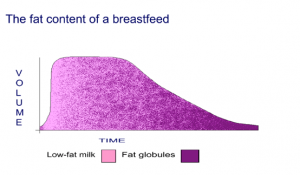
While this might be interesting, for the vast majority of women, the fat content at any particular time is irrelevant. It is far more important for your baby to be offered the chance to take milk from both breasts each time so that they can access the volume of milk that they need overall. There is no such thing as “emptying” or “draining” one side because breasts are never empty, they carry on making milk during the feed. Draining a breast would be like trying to drain a river!
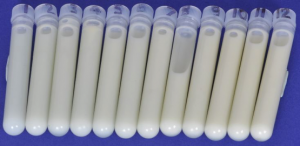
To illustrate the foremilk and hindmilk point, one kind mum pumped her breastmilk for one feed into a series of test tubes. These show how the milk changes gradually through a feed, and that it is all good stuff!
For more information see http://thefunnyshapedwoman.blogspot.co.uk/2011/05/foremilk-and-hindmilk-in-quest-of.html
My baby has green poo, is this too much foremilk or lactose intolerance?
You may have read that green poos result from a foremilk/hindmilk imbalance or even lactose intolerance. Please do not self-diagnose lactose intolerance in your baby. Occasional green poos and unsettled behaviour in a healthy baby are normal. Truly lactose intolerant babies would show signs of severe discomfort and low weight gain, and maybe have consistently explosive frothy green poos. If you are worried about your baby, please have them reviewed by a medical practitioner. For everyone else, you might like to read www.llli.org.breastfeeding-infoc/foremilk-and-hindmilk for reassurance.

Is your baby tracking app actually helping?
When I sit down with a new mum to talk about feeding, she almost inevitably reaches for her phone. “Look, his feeds lasted an average of 29 minutes yesterday, four hours forty seven minutes in total, and here he was overtired in his wake window, and he didn’t get a...

Bottle refusal nightmares
I hear you. It’s getting desperate. You’ve been trying for months to get your baby to take a bottle. You’ve read every forum, your kitchen is bursting with bottles of all shapes sizes and flow rates. You’ve tried all the milks at different temperatures, calm,...

How to choose infant formula milk
in the UK, formula milks labelled number one are suitable for your newborn up to one year of age, After one year, your baby can be offered whole cows milk alongside their solid foods. Breastmilk is the optimal food for your baby, and formula milks offer an excellent alternative if breastmilk is not available,

Baby-led breastfeeding
Relax, recline or lie on your side in bed. Rest your baby where they have their front against you and feel fully supported. They will use their natural instincts to latch on and feed comfortably.

How to choose a bottle
Pick a bottle and teat flow rate suitable for the age of your baby. You might need to experiment to find the optimal bottle for your little one. Conical teats tend to be well tolerated by many babies. New parents often worry about what to buy for their baby, and...

Bottle feeding stress?
Bottle feeding isn’t the easy option! I have worked with thousands of bottle feeding parents. You are not alone with your worries. Here are the top ten things bottle feeding parents stress about. 1. Guilt Whether bottle feeding was a positive choice or forced upon...

Breastfeeding with nipple piercings or tattoos
Can I breastfeed with pierced nipples? Yes! Please remove your nipple jewellery before breastfeeding. Jewellery can easily get dislodged or damage your baby's mouth. Most people take it out for the whole time they are breastfeeding their baby, others do it feed by...

Bottle feeding your fussy four or five month old
Your little one was doing fine with the bottle. You were feeling slightly smug about the great patterns you were getting into. Maybe they were even sleeping a good chunk of the night. Then, from nowhere, they only want to take a few sucks on the bottle and refuse...

Why bottle feed?
As a lactation consultant, I am widely expected to promote breastfeeding, and of course I help families with this. Breastmilk is the optimal food for human babies and breastfeeding can be awesome. However, bottle feeding is a vital part of many families’ feeding...

Top ten reasons why your baby won’t take a bottle
About half of my work is with parents of babies who cannot bottle feed well or refuse a bottle entirely. Frazzled parents are often at the end of their tether, their baby is unhappy and feed times become a nightmare. Sometimes there is a clock ticking, such as a...