
Many new parents believe that feeds should not be linked with sleep, that they must teach their baby to go to sleep on its own, and that schedules and routines will improve everyone’s happiness in the end. Is any of it true?
Is it OK for my baby to feed to sleep?
We are often told that our baby must learn to “self-settle.” That baby must in no circumstances associate feeding with going to sleep, in case it builds an unsustainable reliance on the mother. To promote baby’s independence we are even instructed to rouse our softly sleeping baby after a feed before we put them down to sleep. We wake our contented baby with unnecessary nappy changing and rigorous winding. We structure our older babies’ lives with “eat, play and then sleep” routines. If our baby falls asleep on the breast or in our arms after a feed, we consider ourselves failures. We think that we are creating bad habits. But this is total nonsense.
Dr Pamela Douglas, author of “The Discontented Little Baby Book” explains that these feed, play, sleep cycles mess with babies’ biology. We are being told to ignore the powerful, biological cues of sleepiness at the end of a feed. She writes, “Disassociating sleep from feeds leaves parents rudderless, because the most dominant and repeated cue that baby is ready to sleep has just fallen out of each day.”
Are we making a rod for our own back by letting baby feed to sleep? No, we are keeping in sync with natural processes. Will our baby learn to sleep on their own eventually? Yes, of course, their capacity to self soothe is innate and develops with maturity in the first two years of life. Trying to introduce sleep strategies, especially in the first six months, has no scientifically proven benefit later in life.
Do I have to put my baby down to sleep?
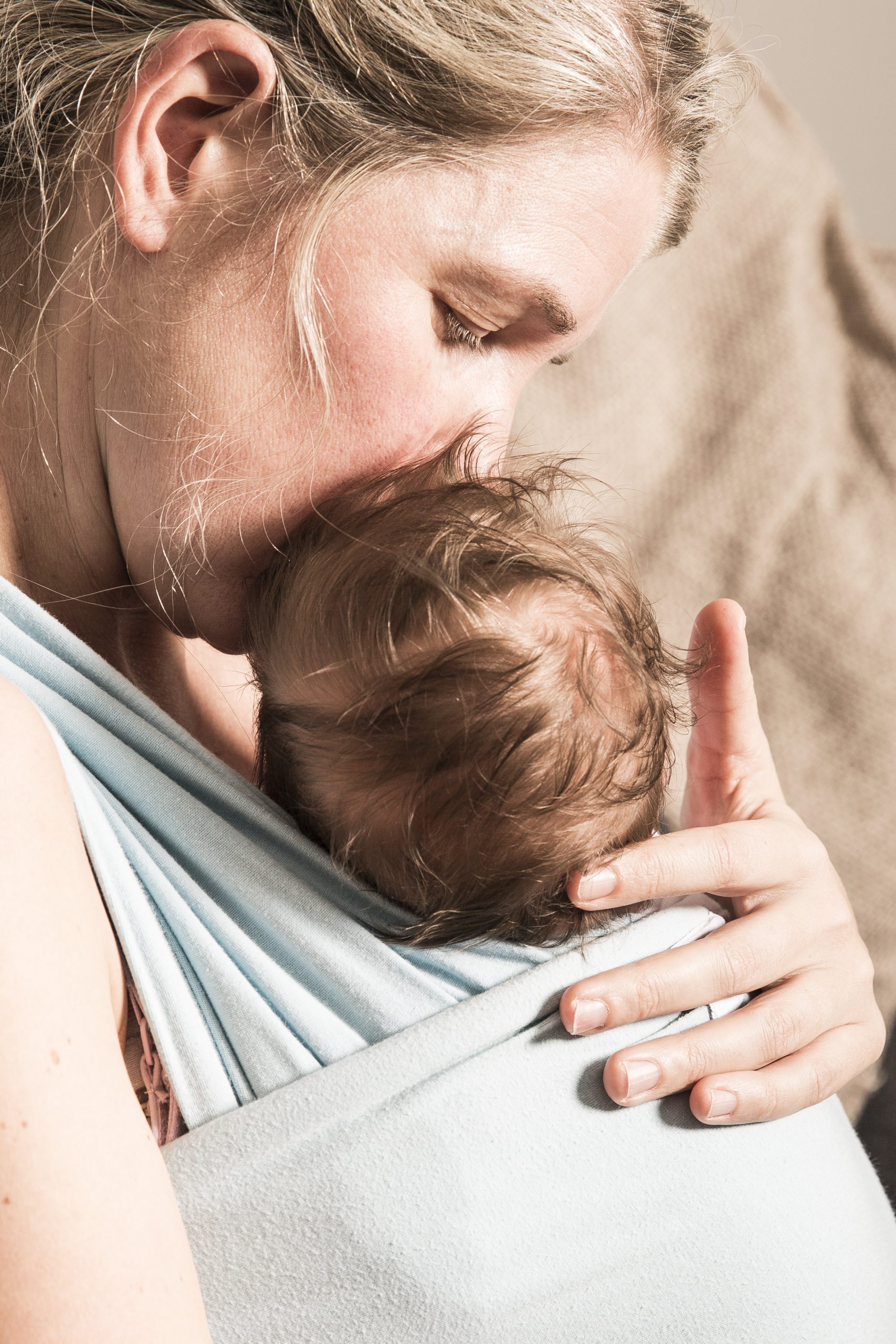
Our babies crave two fundamental things above all else: food, and sensory stimulation. They get food from generous breast and bottle feeding, and sensory stimulation from interaction with their carers and their environment. It is really odd to think that a little baby will want to sleep on its own without the normal noises of daily living and its care givers around. Baby would prefer, of course, to be asleep in someone’s arms or against their chest, but provided that baby is kept safe and close they will generally be fine. Can you feed and cuddle your little one to sleep? Yes, it is one of the joys of parenthood. Is it OK to carry your baby around asleep in a sling? Yes, if it is well fitted and designed so that you can see your baby (upright rather than horizontal) your baby will probably love it. What if your baby prefers to nap when you are outside with a pram. Absolutely fine. Are you setting up bad habits? Of course not. You are working with normal primate behaviour rather than against it. It is great to find ways that allow your baby to sleep while you get on with normal daily life. Experiment and see what works for you.
What about routines? How much sleep should my baby have?
Parents are often amazed to learn that a perfectly normal newborn baby may take anything from nine to 20 hours sleep in a 24 hour period, and that this might vary widely day to day. Even at six months old, healthy babies can sleep from anything from nine to 17 hours out of 24. That might mean that the baby next door sleeps twice as long as your own baby, and that both babies are completely fine. It also explains why rigid sleep routines and schedules are often completely inappropriate and frustrating for the whole family.
Our baby’s sleep, just like our own, depends on two unconscious biological processes: sleep pressure building, and the circadian clock in the brain.
“Sleep pressure” is caused by chemical activity in cells in the body and brain. Sleep pressure builds up while we are awake and dissipates when we sleep. The more tired we are, the longer it takes to go away. Newborn babies get tired quickly, and may need very frequent naps and sleeps. Adults can usually cope with longer periods of being awake, but many of us still like a nap in the day now and then.
Our circadian clock consists of 50,000 cells in our brain and it regulates our bodily functions through the day and night. It is controlled by environmental cues, particularly light falling on the retinas of our eyes. The activities of daily living help to calibrate the clock. We are woken by light, birdsong, the normal noises of a household getting moving. Through the day we respond to cues of sights, sounds and smells, conversations, activities, and these change as we move towards night time. Our newborn babies pick up on all of this too. By two months old they tend to have more of their sleep at night, and by four to six months their circadian clock is more mature. Regardless of whether we do anything. In fact, deliberately shielding our baby from normal noise and light is an odd thing to do. Making them lie in a covered pram or dark room during the day is actually interfering with the process of setting a normal circadian clock.
What? I don’t have to put my baby down for naps at specific times?
We cannot make our babies, or ourselves, go to sleep. We can only remove the obstacles that get in the way of the two processes above. As we have seen, babies need widely different amounts of sleep. Provided that there is nothing in the way of sleep, such as unresolved feeding issues, you can get on with your day safe in the knowledge that your baby will take sleep when they need it.
I imagine that you are raising your eyebrows and thinking “but Gina Ford says…” There are so many books and programmes out there that suggest babies need structure and routines and that it is our responsibility to get them into patterns so they don’t get “overtired.” But think about it. Do you stress that your dog isn’t getting enough sleep? If your dog yawns, do you think “quick, I have to get the dog into a darkened room and make it go to sleep”? You trust that if your dog is tired enough it will curl up and go to sleep by itself. It is just the same with your baby. If you have met your baby’s needs for a full tummy and plenty of sensory stimulation, baby will sleep when they need to.
I think about this a lot, because I meet so many mothers who are at their wits’ ends trying to get their baby into a sleep pattern. The number of coffee mornings lunches and playgroups these mothers miss because they were trying to get, or keep, the baby down in their cot. Poor mothers and babies. They would probably both benefit enormously from getting up or out and doing something! Why rock your baby for hours in a covered pram or stay in a darkened room when you could go out for a walk, meet a friend, strap the baby in a sling and make a cake, sit in the garden or on the balcony, rather than be a slave to what the book says. Up to 20% of women in the UK experience postnatal depression. I wonder whether these unnecessary and unrealistic expectations of our babies and ourselves might contribute to this? The way society makes us believe that we must stay at home to be good mothers. Strict routines can result in us striving, overthinking, doubting, comparing, and ultimately not enjoying these precious times with our babies.
But I need a routine!
Ah, now this is a different thing. Many parents are in the habit of running their day by the clock, and the unpredictability of life with a baby can be overwhelming. In your favour, starting and ending your day at the same time, and keeping within your rhythm, will help your baby’s circadian clock too. Just please do not expect too much from yourself or your baby.
So what about sleep training? Is it harmful?
Luckily for humanity, babies are largely “parent proof.” The sleep training regimes used for toddlers are often applied to new babies, and yet there is no evidence that they work before six months at the earliest. Some people would suggest that they are positively harmful, and there is not much reliable evidence of that either. The book Cribsheet by Emily Oster has a really interesting review of the scientific data on this.
The difficult thing about sleep training for babies is that parents are told to deliberately delay their responses to what they know their baby is asking for, or to not respond at all. Babies have an acute biological need to be close to their parents, and parents are hard wired to respond to their baby. Sleep training, especially “cry it out” methods, means not responding to these needs. This can be very stressful for both babies and parents, and could cause a miscommunication between you. Babies need to learn that their needs will generally be met when they signal them. Once they have learned that, they tend to be calmer overall. Surely our role as parents is to keep things as calm and kind and easy as possible?
Feel free to get in touch to discuss any issues raised by this article.
You might also like to read:
The Discontented Little Baby Book by Dr Pamela Douglas
Cribsheet by Emily Oster