
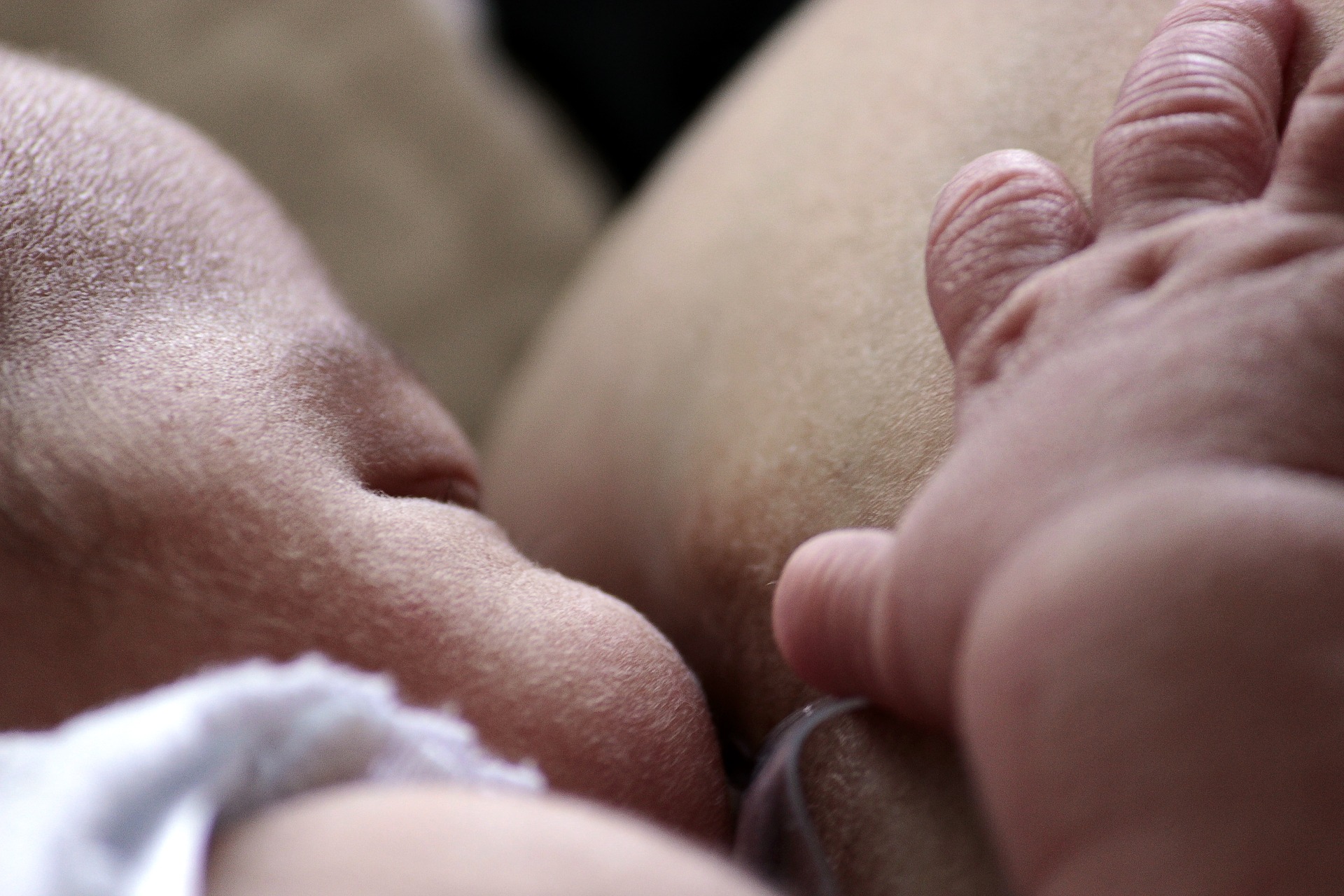
Over the years I have supported many women who have previously had breast surgery, including implants, reductions, biopsies, lumpectomies and mastectomies. Most women who have had breast surgery will produce some breastmilk, but the amount will depend on many things including the reason for the operation, type of surgery, the way it was performed, and when it was done.
If a mother wants to breastfeed, we celebrate any breastmilk that is possible alongside supplementing with formula as necessary.
Breastfeeding with implants (breast augmentation)
Breast implants are used to increase the size of the breasts or for reconstruction after a breast or part of a breast has been removed.
I have worked with many mothers with implants who are fully breastfeeding their babies. If the breasts contained normal breast tissue before having implants, they may not impact a woman’s ability to breastfeed. Implants tend to be inserted from incisions at the sides of the breasts, away from the areola, and behind the breast tissue. Implants positioned directly above the chest muscle are more likely to put pressure on the glandular tissue and block milk flow than implants positioned under the chest muscle. Frequent feeding and/or expressing can help to reduce the feeling of fullness that might impact on milk supply.
Some women get implants as reconstruction after surgery or because of underdeveloped or misshapen breasts on one or both sides. In these cases there may not be sufficient breast tissue available to fully breastfeed their baby.
Over the years I have met several women whose babies were not thriving or putting on weight, and nobody had asked about the development of their breasts in puberty or about corrective surgeries. I find that many health professionals simply do not mention it in conversation, or do not fully read a woman’s notes. This can leave a woman feeling like she is failing somehow, which could not be further from the truth. As ever, babies need to be fed and loved, and it does not really matter how they are fed. If a woman has medical or physiological issues that affect her breastmilk production, or has chosen a course of action in her past that perhaps she now regrets, she needs support and understanding. She should not judge herself or her body, or feel judgment from anyone else.
Breastfeeding after breast reduction
Breast reduction decreases the size of the breasts, and often results in lower breast milk production. The process involves removing breast tissue and excess skin, and very often repositioning the areola by cutting around it. Moving the nipple during breast reduction surgery can injure the milk ducts and affect the nerves and blood supply to the area. Over time, nerves slowly grow back and breast tissue can heal to an extent. If the surgery was performed without cutting the area around the nipple and areola, there is a better chance that breastfeeding will be successful.
In my experience, many women will produce some breastmilk after a breast reduction, but most do not make sufficient milk for the baby even with frequent nursing and expressing. It is likely, and desirable, to supplement the breastmilk with formula top ups by bottle.
Breastfeeding After Reduction (BFAR) has an active website and social media presence for anyone needing more information and support.
Breastfeeding after mastectomy
A mastectomy is the removal of a breast. They may be done because of breast cancer, or some women choose a mastectomy due to very high genetic risk of developing cancer.
After a mastectomy, the breast involved may not be able to produce much milk, if any at all. It depends on how much of the breast tissue is removed and whether any additional treatment is needed. Radiation therapy can cause further damage to any remaining breast tissue.
When one breast is removed but the other is not affected, it is sometimes possible to make enough milk for a baby from just one side without the need for supplementation.
Breastfeeding after a lumpectomy
Women may have lumpectomy surgery to remove a breast lump. A lumpectomy may damage milk ducts, tissue and nerves in that area, and it is likely that this will affect breast milk production in the damaged part of the breast. Less invasive lumpectomies not involving an incision near the areola will probably only have a minor effect.Sometimes radiation therapy is also required, and this can further damage breast tissue.
Breastfeeding after a breast biopsy
Sometimes it is necessary to surgically remove a piece of breast tissue to check for cancer or infection. This is often minor breast surgery and generally does not affect the ability to breastfeed, unless the incision is near the areola and nipple. Incisions that are orientated towards the nipple, like the spokes on a wheel, are less likely to cause nerve and duct damage.
A needle biopsy is performed by inserting a needle into the breast to remove the contents of a breast lump, cyst or abscess. This procedure rarely has a negative effect on milk production or the ability to breastfeed.
Breast lift surgery
Mastopexy repositions the breast tissue to reduce sagging, and implants are sometimes added at the same time to increase fullness. Breast lift surgery by itself does not tend to impact much on milk production because no glandular tissue is removed and the incisions are usually not deep enough to affect critical nerves.
Tips for Breastfeeding After Breast Surgery
Here are some tips for breastfeeding with implants or after breast surgery.
- Contact the surgeon who performed your breast surgery to find out how the procedure was carried out and if it might interfere with your ability to breastfeed.
- Talk to each midwife, obstetrician, your GP and the baby’s pediatrician about your desire to breastfeed, and let them know that you have had breast surgery. Please do not assume that they have read your notes.
- Tell the hospital midwives and feeding supporters about your breast surgery and make sure that they carefully monitor your baby during your hospital stay (see https://cathysage.com/am-i-making-enough-milk-for-my-baby/)
- Focus on your baby’s behaviour and what is coming out in their nappy.
- Take your baby for regular weight checks as indicated by your health visitor.
- Consider attempting to hand express colostrum before your little one is born (see https://cathysage.com/confused-about-expressing/)
- Start breastfeeding your baby as soon as possible after delivery. Keep baby skin to skin if possible and try to feed very frequently, at least every 2-3 hours, to help build up your milk supply. If you can, hand express or use a breast pump for a short time after each feed to ask your breasts to make more milk.
My nipple has gone white at the tip and feels really sore after breastfeeding!
Nipple blanching, or vasospasm, seems to be considerably more common in mothers after breast or nipple surgery. Nobody is quite sure why. Blanching happens when either the tip or whole nipple becomes rigid and blood flow is restricted. The nipple goes white and then sometimes blue. After a time the blood rushes back and the nipple turns purple-red. The nipple may feel numb, burning or tingling or it can cause stabbing pain deep in the breast. Vasospasm can last for several minutes, and the stabbing pains can happen between feeds.
There are other some physiological causes for these blanching episodes, including incorrect positioning and latch, baby having a crunchy tight suck and sometimes tongue-tie, and mothers with Raynaud’s Syndrome. Exposure to cold make nipple blanching worse, and mothers are advised to keep warm and even use heat packs after nursing. Some drugs, such as thophylline, terbutaline, epinephrine, norepinephrine, serotonin, nicotine, and caffeine are known to cause vasoconstriction, which can manifest in the nipple.
Any mother with nipple blanching would benefit from a proper assessment of her breastfeeding by a trained lactation consultant, to figure out what is going on. It might have nothing to do with the surgery. Possible treatment measures depend on the cause.
The Breastfeeding After Reduction website suggests that in the case of Raynaud’s Syndrome, blanching can sometimes be improved by the use of food supplements such as calcium and magnesium, as well as evening primrose oil (gamma linoleic acid), and fish oil (eicosapentanoic acid and docosahexanoic acid) eicosapentanoic acid and docosahexanoic acid). Unfortunately, it can take up to six weeks to see improvement with these supplements.
When the discomfort from nipple blanching is severe, mothers may approach their GP for medication. Many women are prescribed nifedipine, which is a calcium channel blocker. It has been shown to be clinically effective in reducing nipple blanching fifty to ninety-one percent of the time. A small amount of it passes into breastmilk, but this is not considered a significant risk to the baby. As ever, there are some possible side effects, including headache, flushing, dizziness, rapid heartbeat, and oedema in the extremities.
In conclusion, many mothers can produce breastmilk after breast surgery. Experienced, sensitive support from trained professionals, alongside the encouragement of her friends and family, can be invaluable. We can work together to maximise milk supply to the baby, and top up with formula supplements as necessary.
If anything in this article has affected you and you would like a telephone consultation, please do not hesitate to contact me.